Speech delivered: January 5, 2026, United Nations Security Council
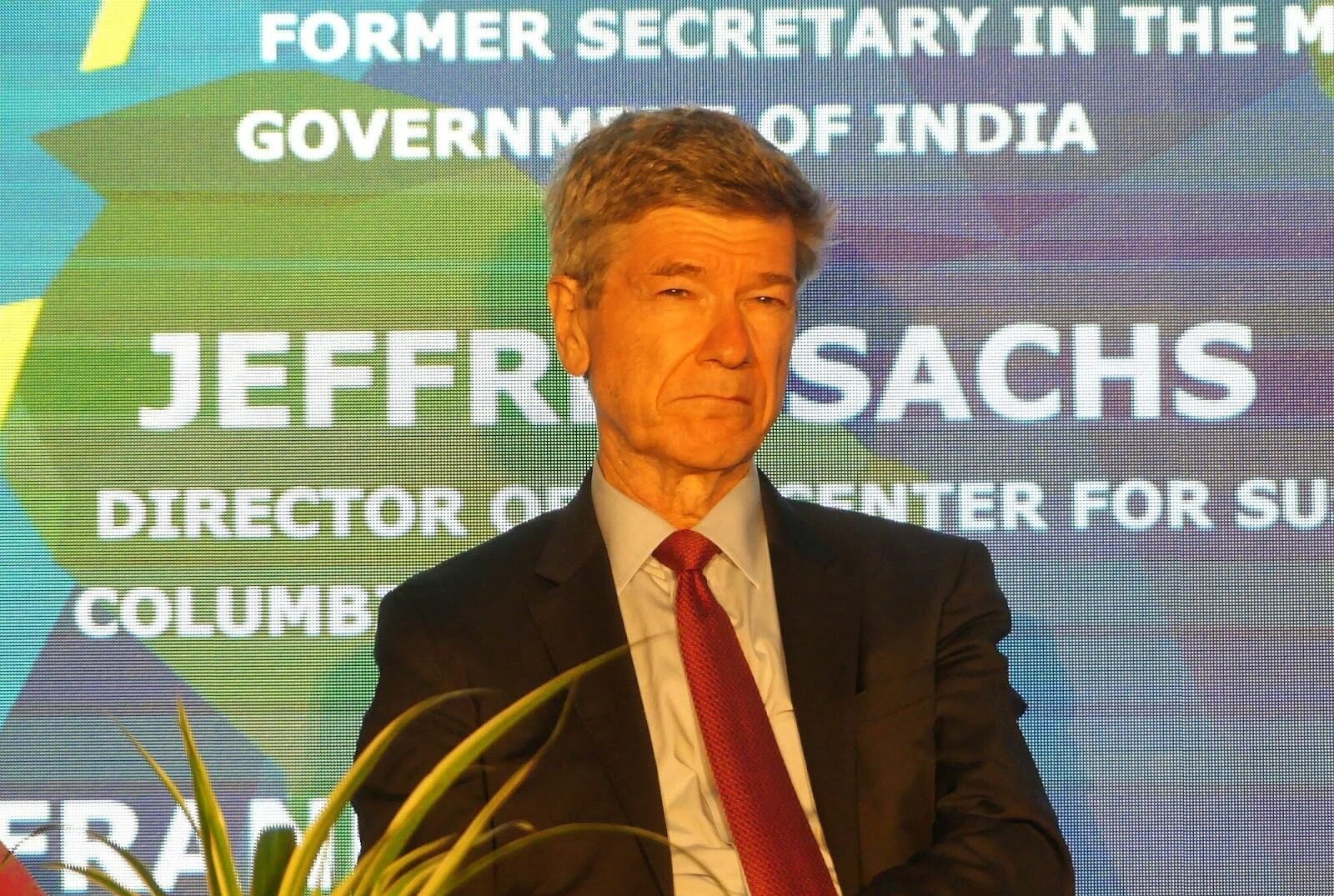
Photo: Jeffrey Sachs. Credit: Elekes Andor / Wikimedia Commons, licensed under CC BY-SA 4.0.
“The UN was created to place international law above anarchy… If the kidnapping of a Head of State and the bombing of a sovereign country are tolerated, the message is that the law is optional and force is the true arbiter of international relations.”
— Jeffrey D. Sachs, briefing to the UN Security Council, January 5, 2026
Professor Jeffrey D. Sachs is President of the UN Sustainable Development Solutions Network and Director of the Center for Sustainable Development at Columbia University.
The following text reproduces, in full and without alteration, Professor Sachs’ briefing to the United Nations Security Council on the situation in Venezuela, delivered on January 5, 2026. The transcript is sourced from JeffreySachs.org and reflects remarks made in an official UN forum. It is reproduced here for informational and educational purposes.
Tessera editorial commentary follows after this briefing.
* * *
Mr. President,
Distinguished Members of the Security Council,
The issue before the Council today is not the character of the government of Venezuela.
The issue is whether any Member State—by force, coercion, or economic strangulation—has the right to determine Venezuela’s political future or to exercise control over its affairs.
This question goes directly to Article 2(4) of the United Nations Charter, which prohibits the threat or use of force against the territorial integrity or political independence of any state.
The Council must decide whether that prohibition is to be upheld or abandoned.
Abandoning it would carry consequences of the gravest kind.
Background and context
Since 1947, United States foreign policy has repeatedly employed force, covert action, and political manipulation to bring about regime change in other countries. This is a matter of carefully documented historical record. In her book Covert Regime Change (2018), political scientist Lindsey O’Rourke documents 70 attempted US regime-change operations between 1947 and 1989 alone.
These practices did not end with the Cold War. Since 1989, major United States regime-change operations undertaken without authorization by the Security Council have included, among the most consequential: Iraq (2003), Libya (2011), Syria (from 2011), Honduras (2009), Ukraine (2014), and Venezuela (from 2002 onward).
The methods employed are well established and well documented. They include open warfare; covert intelligence operations; instigation of unrest; support for armed groups; manipulation of mass and social media; bribery of military and civilian officials; targeted assassinations; false-flag operations; and economic warfare aimed at collapsing civilian life.
These measures are illegal under the UN Charter, and they typically result is ongoing violence, lethal conflict, political instability, and deep suffering of the civilian population.
The case of Venezuela
The recent United States record with respect to Venezuela is clear.
In April 2002, the United States knew of and approved an attempted coup against the Venezuelan government.
In the 2010s, the United States funded civil society groups actively engaged in anti-government protests, notably in 2014. When the government cracked down on the protests, the US followed with a series of sanctions. In 2015, President Barrack Obama declared Venezuela to be “an unusual and extraordinary threat to the national security and foreign policy of the United States.”
In 2017, at a dinner with Latin American leaders on the margins of the UN General Assembly, President Trump openly discussed the option of the US invading Venezuela to overthrow the government.
During 2017 to 2020, the US imposed sweeping sanctions on the state oil company. Oil production fell by 75 percent from 2016 to 2020, and real GDP per capita (PPP) declined by 62 percent.
The UN General Assembly has repeatedly voted overwhelmingly against such unilateral coercive measures. Under international law, only the Security Council has the authority to impose such sanctions.
On 23 January 2019, the United States unilaterally recognized Juan Guaidó as “interim president” of Venezuela and on 28 January 2019 froze approximately $7 billion of Venezuelan sovereign assets held abroad and gave Guaidó authority over certain assets.
These actions form part of a continuous United States regime-change effort spanning more than two decades.
Recent United States global escalation
In the past year, the United States has carried out bombing operations in seven countries, none of which were authorized by the Security Council and none of which were undertaken in lawful self-defense under the Charter. The targeted countries include Iran, Iraq, Nigeria, Somalia, Syria, Yemen, and now Venezuela.
In the past month, President Trump has issued direct threats against at least six UN member states, including Colombia, Denmark, Iran, Mexico, Nigeria and of course Venezuela. These threats are summarized in Annex I to this statement.
What is at stake today
They are not called upon to assess whether the recent United States attack and ongoing naval quarantine of Venezuela result in freedom or in subjugation.
Members of the Council are not called upon to judge Nicolás Maduro.
Members of the Council are called upon to defend international law, and specifically the United Nations Charter.
The realist school of international relations, articulated most brilliantly by John Mearsheimer, accurately describes the condition of international anarchy as “the tragedy of great power politics.” Realism is therefore a description of geopolitics, not a solution for peace. Its own conclusion is that international anarchy leads to tragedy.
In the aftermath of World War I, the League of Nations was created to end the tragedy through the application of international law. Yet the world’s leading nations failed to defend international law in the 1930s, leading to renewed global war.
The United Nations emerged from that catastrophe as humanity’s second great effort to place international law above anarchy. In the words of the Charter, the UN was created “to save succeeding generations from the scourge of war, which twice in our lifetime has brought untold sorrow to mankind.”
Given that we are in the nuclear age, failure cannot be repeated. Humanity would perish. There would be no third chance.
Measures required of the Security Council
To fulfill its responsibilities under the Charter, the Security Council should immediately affirm the following actions:
-
- The United States shall immediately cease and desist from all explicit and implicit threats or use of force against Venezuela.
-
- The United States shall terminate its naval quarantine and all related coercive military measures undertaken in the absence of authorization by the Security Council.
-
- The United States shall immediately withdraw its military forces from within and along the perimeter of Venezuela, including intelligence, naval, air, and other forward-deployed assets positioned for coercive purposes.
-
- Venezuela shall adhere to the UN Charter and to the human rights protected in the Universal Declaration of Human Rights.
-
- The Secretary-General shall immediately appoint a Special Envoy, mandated to engage relevant Venezuelan and international stakeholders and to report back to the Security Council within fourteen days with recommendations consistent with the Charter of the United Nations, and the Security Council shall remain urgently seized of this matter.
-
- All Member States shall refrain from unilateral threats, coercive measures, or armed actions undertaken outside the authority of the Security Council, in strict conformity with the Charter.
In Closing
Mr. President, Distinguished Members,
Peace and the survival of humanity depend on whether the United Nations Charter remains a living instrument of international law or is allowed to wither into irrelevance.
That is the choice before this Council today.
Thank you.
* * *
Normative Erosion Through Practice: Sachs at the Security Council
Commentary
Justinas Stankus, Tessera Research Collective
Professor Jeffrey Sachs’s briefing to the UNSC is a bold critique of the United States military action in Venezuela. His focus, however, is not the character of US intervention itself, but rather the perilous state of International Law—the normative architecture that holds the international constitutive order together. He argues for norm preservation. International Law, codified in the UN Charter, defines sovereignty and governs how states recognize each other’s sovereign authority and conduct international affairs, notably Article 2(4)’s prohibition on the use of force against the territorial integrity or political independence of any state.
Professor Sachs knows that the US will veto any binding measure and that no immediate enforcement will follow; he focuses his efforts on stressing the stakes and what is worth preserving. When Professor Sachs brings to the UNSC’s attention the fact that “the issue is whether any Member State has the right to determine Venezuela’s political future,” he is alluding to the legal-constitutive framework, in which rights, obligations, and legitimate authority come from collective institutionalized agreement, and not from material capabilities. The main question is not whether the US has the right to intervene, but whether we recognize such actions as legal within the normative system the Charter upholds. He appears to deny the US its preferred justificatory terrain, which typically includes democracy, narco-politics, and humanitarianism.
What makes his argument particularly interesting is his attention to practice and precedent as the mechanism of legal erosion. By referencing US regime-change operations from 1947 onward, he shows how repetition of certain actions, when it goes uncontested and insufficiently sanctioned, threatens to create new customary norms that gradually displace written law. This reflects international law’s paradoxical logic: state practice can either reinforce existing norms or, through consistent repetition of breaches, generate competing customary norms that displace written law. Professor Sachs suggests that we are now witnessing the latter process at play: unilateral intervention is being normalized through aggregation, gradually transforming from “transgression” and “violation” into accepted practice. By listing historical transgressions, he invites the UNSC to recognize the systemic pattern that, when unchallenged, has the potential to rewrite the substantive content of Article 2(4) despite its textual stability. The recent bombing operations in seven countries and threats made against six states constitute an acceleration of this normative drift.
Professor Sachs’s statements show concern regarding International Law’s dependence on collective recognition. Sachs distinguishes between enforcement and recognition: the Council need not sanction violations to maintain the law’s constitutive power, but it must explicitly name them as violations rather than remain silent. He clearly understands that the UNSC cannot compel the US to comply with the Charter, but he is asking the Council to perform a “constitutive act”: to reaffirm what constitutes lawful action and what doesn’t—a declaratory restatement of legal obligations. That is why the measures he proposes emphasize cessation, withdrawal, and adherence. He does not suggest sanctions or military intervention.
To illustrate his point about the collapse of international law, he invokes the League of Nations’ failures in the 1930s. It is not the violations of International Law themselves that cause its collapse, but the failure of the collective body charged with articulating normative standards to contest such violations. His statement thus shifts focus from sanctioning the United States to the duty of the international community to state what the law is and to retain the capacity and will to exercise such declaratory functions in a consistent manner.
Professor Sachs invokes nuclear annihilation as the endpoint of normative drift, but this rhetorical escalation risks concealing his central analytical point on how customary practice reshapes law through aggregation. Arguably, that is analytically sounder in light of different deterrence theories. The threshold question is not whether anarchy leads to extinction, but whether declaratory reaffirmation by a Council (whose major powers routinely disregard its pronouncements) can meaningfully reconstitute legal baselines or merely perform the rituals of an already-defunct constitutive order.