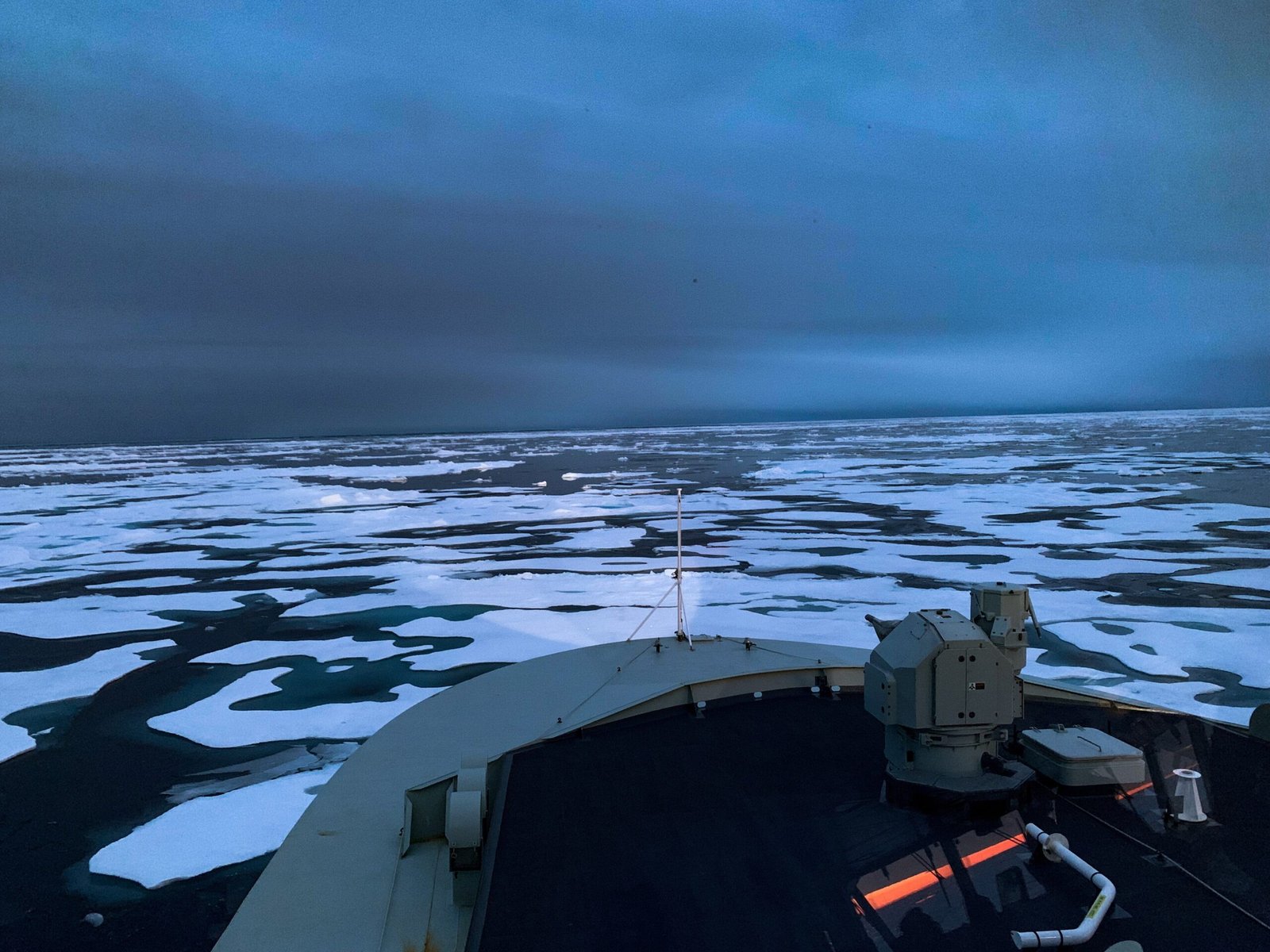
Photo: HMCS HARRY DEWOLF demonstrates her ice-breaking capabilities while transiting the icy waters of the Northwest Passage. U.S. Navy Photo by Lieutenant Junior Grade Kyle Luchau
By: Taylor Stetka
In the ever-changing landscape of national security, understanding emerging threats and building effective response strategies is crucial to maintaining secure governance. In the Canadian context, these threats are most evident in the emerging face of Arctic security concerns. The breakdown of the Arctic Council due to ongoing tensions between several member nations has demonstrated the need for greater national security management of Canadian Arctic territory. The increasing effects of climate change in the region, which have raised concerns surrounding the safety of northern infrastructure and populations, have highlighted Canada’s current shortcomings surrounding security investment and management. As a result of this poor investment and the current lack of an international Arctic security program, Canada is not equipped to address the rise in illegal activity by foreign actors in the Arctic region. Overall, the Canadian government must invest in enhancing defence technology and developing resources to ensure safety and security in the Arctic region.
Breakdown of the Arctic Council
Traditionally, in addition to national management programs, the Arctic region has been overseen by the Arctic Council, which comprises representatives from the eight nations with claims to Arctic land and ocean territories. However, following Russia’s invasion of Ukraine in 2022, the Arctic Council suspended operations for several months before resuming without Russian cooperation and a resulting significant reduction in council activity.1 The government of Canada has officially supported this suspension of cooperation, stating that Russia has shown a “lack of respect for basic international principles of sovereignty and territorial integrity” and so “Arctic states must respond in a strong and coordinated manner… [including] suspending their cooperation with Russia in regional forums such as the Arctic Council.”2 While relations between the seven remaining Arctic Council members had normalized in the following period, Donald Trump’s recent remarks related to potential American territory expansion in Denmark and Canada have once again raised tensions.3 If America is unable to recognize the sovereignty of fellow Arctic Council member states, it would severely limit international cooperation in the region. However, a withdrawal of America from the Arctic Council would also represent a significant decrease in council activity, much like Russia in 2022. While Canada has previously relied on the Arctic Council to coordinate necessary security and development programs, such as in emergency prevention and response, the breakdown of relations between member nations demonstrates the necessity for Canada to maintain an effective national Arctic security program. As well, the Arctic Council provides Indigenous nations, including several in northern Canada, with a platform to discuss the needs of northern communities in development and security.4 A potential breakdown of the Arctic Council would entail a significant loss of Indigenous representation in Arctic security discussions. It is therefore necessary for the Canadian government to expand its collaboration with Indigenous nations in the Arctic to understand the developing needs of Arctic communities.
Climate Change
Climate Change has reshaped the Canadian Arctic, bringing new concerns surrounding development and compounding existing security infrastructure shortages. The most recent national climate change assessment indicates that the Canadian Arctic is warming at three times the global average rate.5 As a result, average summer sea-ice coverage in the region has decreased by about 40% over the past 50 years.6 This environmental change has had detrimental effects on current security and surveillance systems in the region, which are reliant on limited and often outdated infrastructure. Climate change related hazards, such as extreme weather events and stronger offshore winds, have increased the risk of weathering and damage to both military and civic infrastructure.7 This increased risk is especially alarming as the Arctic region is particularly lacking in critical defense infrastructure. Outdated naval vessels, satellites, aircrafts, and communications technology have limited Arctic security capacity, leaving security actors, such as Transport Canada and the Canadian Coast Guard, without the infrastructure necessary to respond to security incidents.8 Therefore, security actors cannot perform effective search and rescue, coastal surveillance, communications, or maritime navigation.9 As a result of these shortcomings in infrastructure and performance, the federal organizations responsible for Arctic security cannot maintain consistent surveillance of maritime activity and are not equipped to handle the increasing security risks in the region.10 While underdeveloped infrastructure limits the efficacy of security initiatives, the increased rate of damage to this infrastructure resulting from climate change is detrimental to Canada maintaining its existing security programs in the region. The Canadian Government has struggled to replace and repair infrastructure when necessary, with earlier speeds of weathering and damage.11 Maintaining this level of investment and repair with the increased rate of weathering would represent a premature collapse of the current Arctic security system. Therefore, the increased weathering and damage associated with climate change, as well as the critical shortage of defence infrastructure, necessitate further investment and development in the region to achieve a holistic and effective Canadian Arctic security program.
Economic Activity
The most pressing concern surrounding Canadian Arctic security is the drastic increase in naval activity in the region. The reduction in sea ice levels has made the Arctic more accessible than ever before to ships, with international vessels being drawn to the region due to the emerging potential of trans-arctic trade and the surplus of natural resources.12 As a result, naval travel in the Canadian Arctic Ocean has more than tripled over the past 30 years.13 While this increase may offer large economic benefits for the Canadian government, it also increases the risk of unauthorized vessel transit and illegal activity in the region, such as illegal fishing, resource extraction, and marine pollution.14 While illegal activities are an obvious concern, unauthorized vessel transit also risks potential safety incidents for these vessels, which puts further strain on Arctic search and rescue. Notably, this increased access to the Arctic is facilitated through the Northwest Passage, which the Canadian Government currently struggles to maintain adequate surveillance of, leading to several failures in responding to illegal activity by naval vessels in the region.15 Moreover, in its current state, due to the limited supply of Canadian Arctic technology and infrastructure, primarily Arctic ports and naval vessels, the Canadian Coast Guard cannot address the increased presence of international vessels to the extent necessary to protect Canadian security.16 As international vessels, especially from non-Arctic nations, continue to appear in the Canadian Arctic Ocean at an increasing rate, the Canadian Government must improve security and surveillance infrastructure to ensure that international vessels follow Canadian regulations. These improvements could take many potential forms, investment in repairing weathered and damaged infrastructure, replacing outdated technology, expanding current security programs such as emergency search and rescue, and increasing manpower and collaboration with Arctic communities. While implementing any of these changes would benefit Canadian Arctic security, implementing all of them is necessary to maintain a holistic northern security program. Overall, the Arctic naval security system cannot effectively meet existing security needs; in its current state, it is entirely unequipped to address the projected increase in activity in the region.
Conclusions
When considering effective national security and defence, the Arctic has posed a persistent challenge for the Canadian Government. However, several developments in Canadian foreign relations and international trade have demonstrated the failures of existing security structures, including shortcomings in infrastructure, technology, and surveillance, which have left the Canadian Arctic particularly vulnerable. Improvements in security and surveillance technology and reinvestment in Arctic infrastructure are essential if the Canadian Government is to effectively adapt to modern security concerns and the changing international stage.
About the Author
Taylor Stetka is a final-year undergraduate student at the University of Toronto with experience in policy research, compliance analysis, and nonprofit administration. They serve as Lead Policy Researcher at The PEARS Project and as a Compliance Analyst with the G7 Research Group, and previously supported national emergency funding and donor relations at the Shine Through the Rain Foundation.
Endnotes
1. Marc Jacobsen Rottem and Svein Vigeland, ‘The Arctic Council in the Shadow of Geopolitics,’ The Arctic Institute, https://www.thearcticinstitute.org/arctic-council-shadow-geopolitics/. ↩
2. Standing Committee on National Security, Defence and Veterans Affairs. (March 21, 2023). Minutes of Proceedings. 44th Parliament. https://sencanada.ca/en/Content/Sen/Committee/441/SECD/03EV-55417-E. ↩
3. Rottem and Vigeland, ‘The Arctic Council in the Shadow of Geopolitics’. ↩
4. Marc Jacobsen Rottem and Svein Vigeland, ‘The Arctic Council in the Shadow of Geopolitics’. ↩
5. Senate Committee on National Security, Defence and Veterans Affairs. (June 2023). Arctic Security Under Threat: Urgent Needs in a Changing Geopolitical and Environmental Landscape. 44th Parliament, 1st sess. Rept. 1. 43. ↩
6. Government of Canada, ‘Report 6—Arctic Waters Surveillance,’ Office of the Auditor General of Canada (2022). ↩
7. Mudryk, L. R., Dawson, J., Howell, S. E. L., Derksen, C., Zagon, T. A., & Brady, M. “Impact of 1, 2 and 4 °C of global warming on ship navigation in the Canadian Arctic,” Nature Climate Change, 11 (2021). 678. https://doi.org/10.1038/s41558-021-01087-6 ↩
8. Government of Canada, ‘Report 6—Arctic Waters Surveillance’. ↩
9. Government of Canada, ‘Report 6—Arctic Waters Surveillance’. ↩
10. Government of Canada, ‘Report 6—Arctic Waters Surveillance’. ↩
11. Government of Canada, ‘Report 6—Arctic Waters Surveillance’. ↩
12. Mudryk et al., ‘Impact of 1, 2 and 4 °C of Global Warming on Ship Navigation in the Canadian Arctic’, 673. ↩
13. Government of Canada, ‘Report 6—Arctic Waters Surveillance’. ↩
14. Government of Canada, ‘Report 6—Arctic Waters Surveillance’. ↩
15. Government of Canada, ‘Report 6—Arctic Waters Surveillance’. ↩
16. Senate Committee on National Security, Defence and Veterans Affairs. Arctic Security Under Threat: Urgent Needs in a Changing Geopolitical and Environmental Landscape. 44th Parliament, 1st sess. Rept. 1. 49. ↩
Bibliography
Canada, Senate of. ‘Standing Senate Committee on National Security, Defence and Veterans Affairs (44th Parliament, 1st Session)’. SenCanada. Accessed 27 September 2025. https://sencanada.ca/en/committees/secd/.
Canada, Senate of. ‘Standing Senate Committee on National Security, Defence and Veterans Affairs (44th Parliament, 1st Session)’. SenCanada. Accessed 27 September 2025. https://sencanada.ca/en/committees/secd/.
Government of Canada, Office of the Auditor General of Canada. ‘Report 6—Arctic Waters Surveillance’. 15 November 2022. https://www.oag-bvg.gc.ca/internet/English/att__e_44160.html.
Mudryk, Lawrence R., Jackie Dawson, Stephen E. L. Howell, Chris Derksen, Thomas A. Zagon, and Mike Brady. ‘Impact of 1, 2 and 4 °C of Global Warming on Ship Navigation in the Canadian Arctic’. Nature Climate Change 11, no. 8 (2021): 673–79. https://doi.org/10.1038/s41558-021-01087-6.
Rottem, Marc Jacobsen, Svein Vigeland. ‘The Arctic Council in the Shadow of Geopolitics’. The Arctic Institute – Center for Circumpolar Security Studies, May 2025. https://www.thearcticinstitute.org/arctic-council-shadow-geopolitics/.