With Myanmar’s final election phase ending on January 26, 2026, this report argues that lasting stability depends less on the electoral process than on curbing the military’s corrupt revenue networks and coercive autonomy.
Introduction: Corruption and Conflict within the Security Sector
Corruption is often a significant factor in civil conflict dynamics: it generates grievances that mobilize opposition and presents opportunities for successful violent resistance. Embedded corruption in the state’s security sector is especially destabilizing. Security sector corruption refers to systemic and institutionalized corrupt practices including embezzlement, arbitrary procurement, bribery, patronage-based promotion, and legal impunity within the military and security apparatus. It undermines meritocratic command structures, operational effectiveness, and civilian oversight. In extreme cases of military political dominance, it also includes military-controlled commercial enterprises and affiliated paramilitaries that generate off-budge revenue and entrench coercive autonomy. Such cases enable the security sector to resist accountability, and capture state institutions. A corrupt security sector can both fuel grievance formation and degrade battlefield effectiveness, prolonging conflict once violence begins. Military-elites leverage control over coercive institutions and off-budget revenue streams to political and economic systems while repressing opposition and concealing corruption under the guise of national security.
This report argues that Myanmar’s persistent civil conflict is partly explained by a specific mechanism: security sector corruption increased the military’s autonomy from civilian oversight, sustaining coercive capacity while insulating elites from accountability. In Myanmar, the coercive autonomy of the military through off-budget revenue, patronage and rent-seeking both enabled state capture in 2021 and degraded battlefield effectiveness contributing to prolonged civil conflict.
Literature Review
State Capacity and Civil Conflict
Foundational literature describes the relationship between civil conflict and weak state capacity, which lowers the barriers to rebellion by shaping both motivation and opportunity. Motivation is often defined by identity-based networks, especially ethnic cleavages, where discriminatory state practices generate mobilization. Opportunity increases when state institutions are unable to deter, police, or suppress armed challengers, particularly in settings characterized by inequality, lootable resources, and corruption. These arguments establish why institutional weakness and coercive underperformance matter for conflict onset, but they do not specify the distinctive role of corruption inside the security sector as both a source of coercive weakness and a pathway to military-elite state capture.
Corruption and Grievance Formation
A substantial literature connects corruption to grievance formation by weakening institutional legitimacy, enabling discriminatory governance, and deepening economic insecurity. Corruption is associated with poor economic growth and misallocates public resources toward rent-rich sectors such as defense and large-scale infrastructure, while concealment costs and fragmented authority further amplify inefficiency. These dynamics erode public trust and increase resentment toward the state, creating fertile conditions for opposition mobilization. However, much of this literature treats corruption primarily as a civilian governance pathology; it pays comparatively less attention to the security sector as a uniquely consequential site for corruption.
Security Sector Corruption and Military Effectiveness
Security sector corruption is especially risky because defence establishments combine high-discretion, procurement complexity, and limited external scrutiny such that they are structurally prone to embezzlement and patronage. Gentil-Fernandes and Otto found that corruption significantly degrades effectiveness in interstate conflict. Binetti shows similar effects in civil war, particularly for forces operating far from logistical where weak supply chains, leadership failures, and poor equipment become decisive. Comparative cases have provided evidence that security sector corruption can prolong civil conflict by simultaneously degrading battlefield effectiveness while entrenching coercive autonomy.
In the first Chechen War (1994-1996), corruption degraded the effectiveness of the Russian military: officers siphoned funds, equipment was sold or neglected, units withheld supplies unless bribed and soldiers reportedly sold arms to Chechen insurgents while looting. In Sri Lanka’s 1983-2009 civil war, emergency national security measures displaced normal legal constraints and insulated the security establishment from scrutiny, so procurement scandals were difficult to investigate and accountability was repeatedly blunted. During Nigeria’s counterinsurgency against Boko Haram (2010-2015), roughly ~$14bn USD in security spending coincided with major procurement diversion, dozens of unexecuted contracts worth $2.1bn USD and high value arms deals that yielded embezzlement or defective deliveries – leaving frontline units under-supplied, demoralized, and prone to desertion. Across cases, once corruption embeds in the security sector, especially with legal impunity and financial embezzlement, elites can profit from continued violence even as military performance declines.
Theory and Hypotheses
Corruption is commonly distinguished between petty corruption – low-level bribery and selective rule enforcement – and grand corruption, in which senior officials manipulate institutions for personal gain through collusion with private and criminal actors. In extreme cases, grand corruption enables elite state capture, whereby political and military leaders systematically control legal frameworks and institutions to preserve their power and rents, thus undermining democratic accountability and the rule of law.
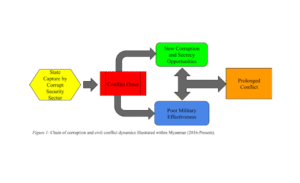
Security sector corruption, as used here, refers to systemic and institutionalized corruption within the military and security apparatus through practices including embezzlement, arbitrary procurement, bribery, patronage based promotion/recruitment, and legal impunity. It undermines civilian oversight, meritocratic command structures, procurement processes, logistics and strategic planning. Where the military holds political dominance, the concept also includes military-controlled commercial enterprises and affiliated militias that enable off-budget revenue and spending. Such dynamics entrench coercive autonomy, reduce exposure to civilian oversight and enable state capture by security elites.
There are three dynamics that we expect to happen in cases where there is both grand security sector corruption and state capture by that security sector:
- As a state with entrenched security sector corruption transitions to a war economy, a cycle emerges in which military elites engage in war profiteering through continued and expanded corrupt practices, thus developing a self-interest in the war continuing.
- Consequently, they increase secrecy and use national security as a guise to limit the freedom of the public to expose corruption.
- A corrupt military will be limited in its effectiveness, especially when operating at the periphery of the state where the consequences of corruption: poor morale, logistics, and strategy will be more pronounced.
A corrupt state captured by the security sector will develop an interest in prolonging conflict while the probability of victory decreases. Figure 1 visualizes the theoretical interactions expected in Myanmar. Myanmar is selected because it is a recent case of state capture by a corrupt security sector. There is a long history of the Tatmadaw corrupting Myanmar’s political institutions since its 1948 independence, but this analysis will focus on the period from 2016 through the 2021 coup to 2025 for both analytical and policy-relevant reasons. Analytically, this period captures the first sustained effort by an elected civilian government to constrain military power by introducing accountability reforms aimed at curbing the military’s corrupt practices within the 2008 constitutional order. The military’s reaction to these reforms demonstrates how entrenched security sector corruption enables rapid state capture once their core interests are threatened. Political uncertainty after state capture created the opportunity and motivations necessary for historically disadvantaged ethnic groups on Myanmar’s periphery to organize stronger armed rebellion. During the conflict, the military has strategically prioritized protecting and hiding corrupt practices that enable their coercive autonomy contributing to conflict persistence. From a policy perspective, this timeframe encompasses the collapse of internationally supported democratic reforms and the onset of an ongoing civil conflict and humanitarian crisis. It also explains the conditions foreign governments continue to confront in designing sanctions, engagement strategies, and support for accountability mechanisms in a fractured and corrupt Myanmar.
Case Study
Institutional Preconditions for Security Sector Capture
From independence, Myanmar’s political order was dominated by armed rebellions and a security-first state-architecture that elevated the military, called the Tatmadaw. The military first intervened from 1958-1960 when it led a temporary emergency government directed at ending civil conflict. Military governance was consolidated through General Ne Win’s 1962 coup after a failure to establish a federal system capable of accommodating ethnic political demands on the state’s periphery. Military rule persisted through several successive authoritarian arrangements. The violent suppression of the 1988 pro-democracy uprising, and the refusal to honour the National League of Democracy (NLD) led by democratic activist Aung San Suu Kyi’s 1990 electoral victory, established a durable pattern: the Tatmadaw would block political transitions that threatened its institutional autonomy and interests.
Claims that Myanmar’s hybrid regime under the 2008 constitution was a transition towards democratization obscured the extent to which it legally entrenched Tatmadaw political autonomy. It reserved 25% of seats in parliament to the military and gave the military veto power over all future constitutional amendments. Control of the Ministries of Defence, Home Affairs, and Border Affairs was allocated to serving military officers, eliminating meaningful civilian oversight of the security sector. Since the 1962 coup, the judiciary has operated without meaningful autonomy from military leadership, undermining impartial adjudication and enabling corrupt military activities and protecting the Tatmadaw’s interests.
These institutional arrangements set the conditions under which the Tatmadaw executed a coup of the civilian administration on February 1, 2021. Following the NLD’s return to government after the 2015 elections, Suu Kyi’s administration pursued incremental reforms aimed at limiting military autonomy and corruption, including efforts to amend the constitution and strengthen civilian oversight. In 2019, the NLD proposed over a hundred constitutional amendments designed to reduce the Tatmadaw’s entrenched privileges. The party’s renewed electoral mandate in 2020 after a landslide election victory intensified tensions with military leadership, providing the immediate pretext for intervention. As in 1962 and 1990, the Tatmadaw responded to reform not with negotiation but with direct seizure of the state, activating long-standing institutional mechanisms of security sector capture to facilitate military-led rentier capitalism.
State Capture and Conflict Escalation After 2021
Following the coup, the Tatmadaw established the State Administration Council (SAC) which reorganized Myanmar’s state apparatus into a military government. The SAC absorbed executive authority and governed by decree while hollowing out civilian administration operating under a prolonged state of emergency that bypassed parliament and suspended elections. Military officers were inserted into civilian administrative roles, and many former civil servants have fled the country. The SAC’s Chairman Min Aung Hlaing simultaneously assumed roles as Prime Minister and Commander-in-Chief of the armed forces, subordinating all civilian administrative functions to the personal interests of the military elite.

Image Source: Rafal R., A Simplified Map of the Myanmar Civil War, December 22, 2025, Map, Own work, derivate of Myanmar civil war.svg and Myanmar adm location map.svg by NordNordWest. Citing @ThomasVLinge, @MyanmarWarMap, @Myanmar Map, @Nrg8000, @TheBorysk, https://commons.wikimedia.org/w/index.php?title=File:Myanmar_civil_war_simplified.svg&offset=&limit=500#filehistory.
Before the coup, several major EAOs, most notably the Arakan Army (AA) in Rakhine, the Kachin Independence Army (KIA) in Kachin, and Karen National Union (KNU) in Kayah, sustained armed resistance alongside uneven implementation of the Nationwide Ceasefire Agreement (NCA). In Shan, non-signatory forces including the Ta’ang National Liberation Army (TNLA), Myanmar National Democratic Alliance Army (MDNAA) retained independent capacity and territorial footholds while the United Wa State Army (UWSA) maintained a heavily armed autonomous zone on the Chinese border. After the coup, the emergence of popular People’s Defense Forces (PDFs) scaled resistance nationally and enabled EAOs to convert longstanding grievances into an opportunity structure for Tatmadaw defeats.
The Political Economy of the Tatmadaw
Economic life in Myanmar is defined by an enduring war economy in which the Tatmadaw has historically prioritized resource extraction and market monopolization over territorial or human security. Their corrupt system evolved from the 1962 transition to a socialist command economy into a contemporary model of military dominated rentier-capitalism. There are two pseudo-private corporations the Myanmar Economic Corporation (MEC) and Myanmar Economic Holdings Limited (MEHL), and a network of pro-military militia cronies that they have used to control natural resources, and public assets. These entities and networks allow the military to draw vast, secretive income from sectors including banking, real estate, mining, tobacco, logging, oil and gas, and tourism, effectively hollowing out the national budget while diminishing any potential for civilian economic competition. In conflict-ridden Kachin and Shan, the military profits from unregulated jade extraction estimated in 2014 to be worth $31bn USD, which is equivalent to roughly half of Myanmar’s total GDP at the time. Such revenues were utilized to fund military purchases and the personal wealth of military officers rather than public services. The Tatmadaw also sanctioned a multibillion-dollar methamphetamine trade in which pro-military militias and Border Guard Forces oversee production and trafficking in exchange for taxation and protection.
The China-Myanmar Economic Corridor (CMEC) that runs across the country from Shan State’s border with China to the port of Kyaukphyu in Rakhine is a critical geographic node facilitating extractive industry. Large infrastructure projects the Muse-Mandalay Railway and Myitsone Dam are joint-ventures between the MEC/MEHL and Chinese state-owned enterprises that forcefully displaced local populations against their will without adequate compensation or local consultation. The 2008 constitution provided the legal architecture to insulate corruption from accountability. This granted the military a de-facto veto over fiscal oversight and ensured the Office of the Auditor General remained powerless to investigate the military’s sprawling business interests vested in the MEC and MEHL. Consequently, the pre-coup economy was described by civilians as an environment where corruption was deeply entrenched through institutions and a network of cronyism, embezzlement and bribery. The United Nations Human Rights Council (UNHCR) reports many violations of international human rights law have been committed by the military in conducting their business, including targeting civilians for information on natural resources, witnessing illegal resource extractions, and protesting environmental hazards.
In contrast to the Tatmadaw’s predatory extraction, EAOs like the AA and KIA have sought to improve their own administrative legitimacy by delivering public services and establishing rudimentary dispute-resolution mechanisms in areas they control. The 2021 coup triggered a nationwide Civil Disobedience Movement (CDM) in which hundreds of thousands of civil servants refused to work for the SAC regime effectively bringing the banking system and infrastructure to a halt. PDFs, at the direction of the NUG, have refused to comply with civil data collection for voter lists successfully assassinating collection officers and raiding civil data repositories dealing a significant blow to the regime’s human intelligence collection. To fund the war, machine resources have been diverted from essential services, causing a total collapse of the health and education systems leading to surging rates of poverty (doubled since 2019), malaria, HIV, and tuberculosis.
Macroeconomic indicators show a prolonged war-economy collapse. The World Bank’s December 2025 Myanmar Economic Monitor estimates real GDP contracted -9% in FY2020-21 and -12% in FY2021/22, growth has stagnated thereafter. Inflation persisted extraordinarily high: near 30% on a year-average basis since FY2022/23, only projected to ease gradually through FY2026/27. Since the coup, illegal rare earth mining has surged with exports to China doubling, providing a critical revenue lifeline to the Tatmadaw and SAC. Border regions have also become a safe haven for transnational online scam operations run by Chinese criminal syndicates in large compounds linked to human trafficking, money laundering, and forced labour. Although the Tatmadaw recently staged high-profile crackdowns on some scam centres, reporting indicates that these operations were protected by military-aligned militias generating substantial illicit revenue for regime-connected actors.
Military Ineffectiveness and Repression
Over the next two years, the Tatmadaw suffered unprecedented territorial losses in the Rakhine, Kachin and Shan as the EAOs increasingly collaborated finding success using guerilla tactics, infrastructure sabotage, and drones. The KIA collaborated with the PDFs using guerilla tactics and local knowledge to score major victories in the months following the SAC coup such as the capture of the Alaw Bum strategic mountain base. Operation 1027 launched by the Three Brotherhood Alliance (MNDAA, TNLA, and AA) captured over 100 military positions in Shan eventually resulting in the January 2024 surrender of over 2,400 Tatmadaw troops and 6 generals – the largest single surrender in the military’s history. The operational effectiveness of post-coup resistance is in-part due to the tiered coordination model facilitated by the National Unity Government (NUG) formed in 2021 by NLG lawmakers in exile. EAOs and the PDFs are indispensable armed partners in the NUG alliance that derive their political legitimacy from the Federal Democracy Charter agreement to defeat the SAC regime and re-constitute Myanmar as a federal democratic union. PDF strength estimates expanded from 65,000 in 2022 to 85,000 in 2024 since EAOs provided them sanctuary, training and arms. By 2025, the military’s territorial control had contracted to just 21% of the country, while its active troop strength reportedly dwindled from 300,000 to approximately 130,000. The territorial collapse of the Tatmadaw occurred despite the NUG’s limited command and control over the PDFs while fundamental disagreements still exist between the NLD and EAOs over the Federal Democracy Charter.
The systemic corruption that enabled the Tatmadaw to dominate Myanmar’s economy and capture the state directly precipitated the decline in battlefield effectiveness it has experienced since the SAC coup. An independent assessment of Myanmar’s security sector by Transparency International’s Government Defence Integrity Index, published shortly after the coup, classified Myanmar as facing a critical risk of corruption across political, financial, personnel, operational and procurement dimensions. The report noted the lack of civilian oversight of defence policy and budgeting, and that anti-corruption mechanisms such as auditing, whistleblower protections, and personnel accountability institutions were either absent or deliberately obstructed. Such conditions enabled systemic embezzlement, patronage-based promotion, and corrupt procurement practices that directly degraded operational readiness while insulating officers from accountability. Front-line units suffer from failing logistics, substandard rations and equipment, and deflated morale. Consequently, the military has failed to adapt to the asymmetric tactics and weaponized drone swarms of the resistance instead reverting to an over-reliance on indiscriminate artillery and airstrikes to compensate for its hollowed-out infantry capabilities.
The Tatmadaw’s counterinsurgency strategy “Four Cuts,” in place since the 1960s, prioritizes cutting-off insurgent organizations from resources and the civilian population. The strategy is deployed as a veil to secure lucrative natural resources and justify the use of scorched-earth tactics that often leave entire villages destroyed. The nation’s intelligence and police institutions function primarily as corrupt regime-protection bodies using surveillance, arbitrary detention, and violent coercion to suppress scrutiny and insulate military elites from accountability. The Assistance Association for Political Prisoners (AAPP) reports that between the coup and 2026, the Tatmadaw was responsible for at least 7,695 civilian deaths and over 30,000 arrests with over 22,000 political prisoners actively detained, including NLD leader Aung San Suu Kyi.
Despite extensive international sanctions ramped up following the coup, UN investigations indicate the Tatmadaw continued to acquire arms, dual-use technology and aviation fuel. The Directorate for Defence Industries (DDI) manages a clandestine global procurement network using a few key partners, intermediary states, and military-linked front companies. Singapore based firms, such as Excellence Metal Casting and STE Global Trading Pte Ltd, are linked to the DDI facilitating overseas procurements. The Burmese conglomerate Asia World Group, whose leadership has been accused of money laundering for the Tatmadaw, utilizes its overseas branches in Singapore to finance the regime’s operations bypassing traditional oversight. Deep-rooted economic relationships with key partners in ASEAN, China, Russia, and India which failed to participate in the Western-led sanctions are the source for most of the Tatmadaw’s foreign arms and dual-use purchases.
Conclusion
This report argued that security sector corruption plays a distinct role in civil conflict dynamics because it simultaneously:
- Generates grievance and repression incentives through coercive autonomy and off-budget war economies, and
- degrades battlefield effectiveness through embezzlement, patronage hierarchies, arbitrary procurement, that produce poor morale, logistics, and strategy.
Using Myanmar, it traced how the Tatmadaw’s constitutionally protected autonomy and military-controlled commercial empire prevented civilian oversight and enabled rapid state capture after reform attempts threatened military elites’ rents. In the post-coup period, the same corruption that insulated the military from accountability also hollowed out its battlefield effectiveness, contributing to territorial losses and reliance on indiscriminate violence. Procurement networks and external partnerships sustained access to arms and dual-use inputs despite international sanctions.
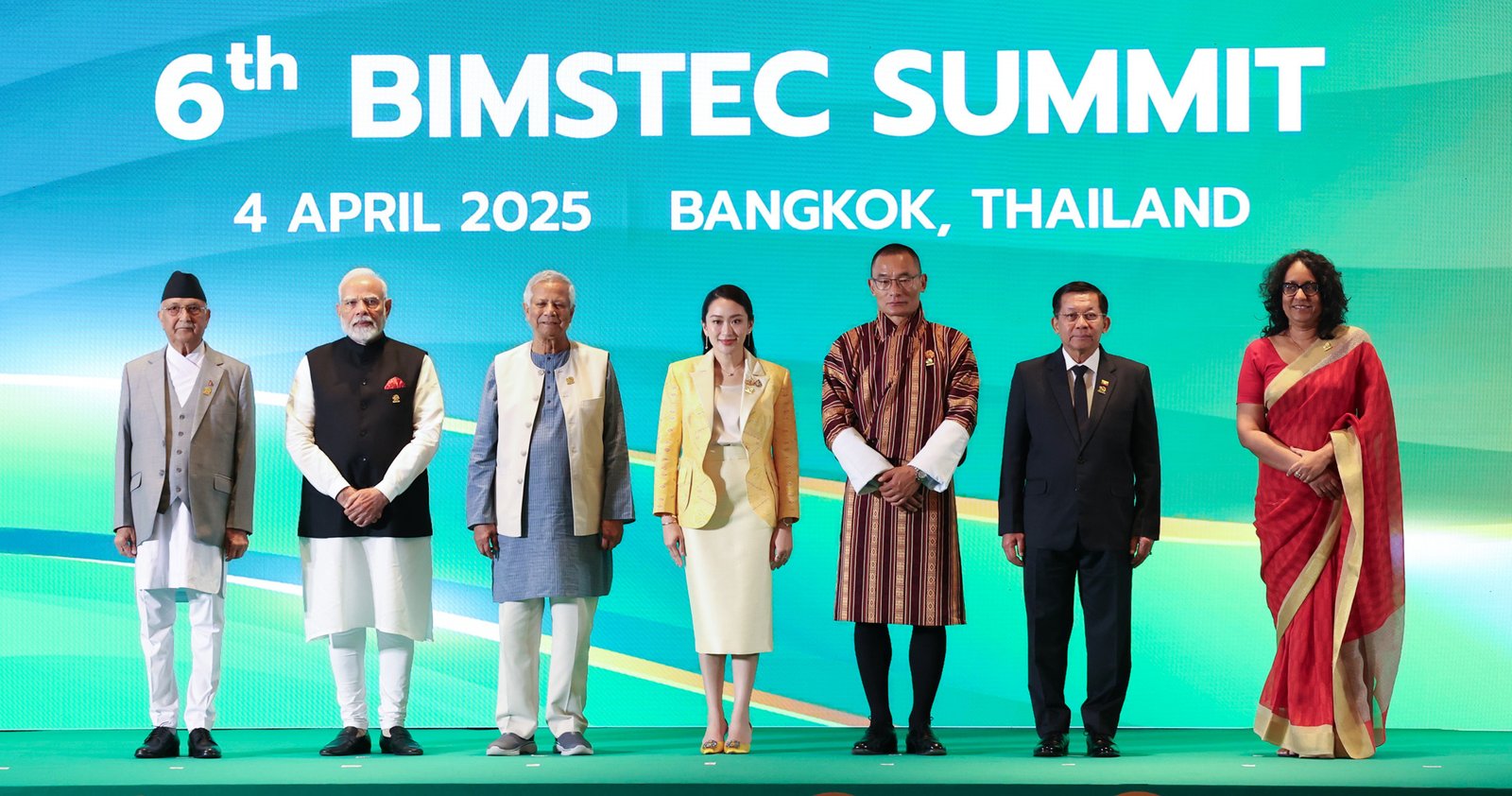
The regime’s phased elections between December 28, 2025, and January 25, 2026, should therefore be interpreted not as an honest attempt at re-democratization. It is an adaptive strategy to stabilize military-elite rent-sharing and reduce uncertainty for external partners while preserving underlying coercive autonomy that security sector corruption relies upon. China especially has pressured for elections to go ahead hoping for a more stable political and security environment that reduces risk on their CMEC investments. Reports after polls closed in the first two phases suggest the Tatmadaw’s proxy party, the Union Solidarity and Development Party (USDP) is projected to win a strong parliamentary majority. The phased structure of elections enables the military to focus its limited security and administrative capacity on controlling smaller areas rather than the majority of the country. Regional actors such as India, Thailand, and Malaysia (current ASEAN chair) began to normalize their relations with the military regime, including high-profile meetings between Min Aung Hliang and their heads of state. ASEAN continues to engage with the NUG however, in the hope that a peaceful settlement to the current conflict might one day be possible. Under the Trump administration, the US has also shifted its policy ending the USAID mission, acknowledging Min Aung Hlaing’s leadership in a tariff announcement and failing to join criticisms of the recent elections; a shift that implies acceptance of the Tatmadaw regime as legitimate. As external constraints weaken, the risk of continued conflict is high and a deeper institutionalization of the corrupt war economy is likely as violence remains profitable even as the regime’s capacity to govern and win decisively erodes.
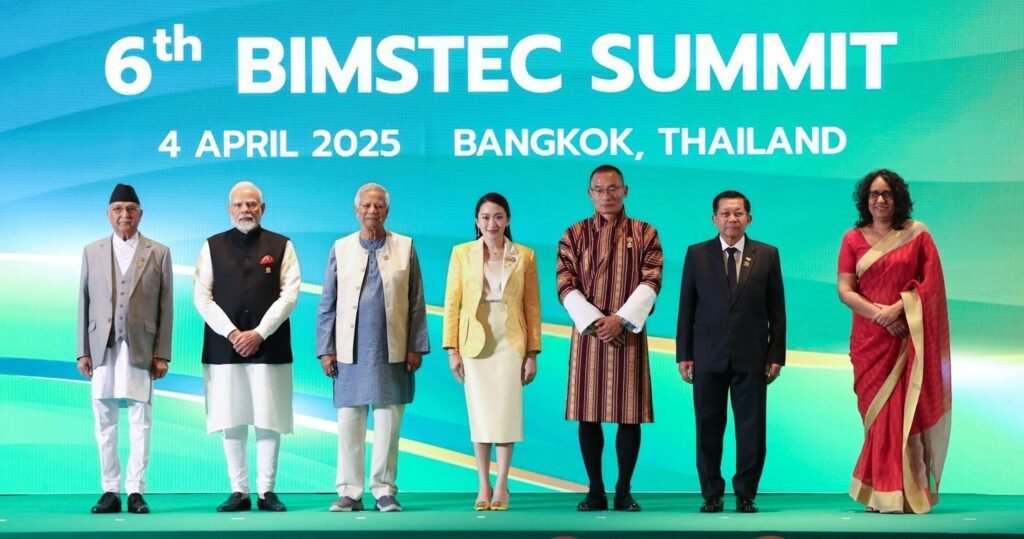
Left to Right: K.P. Sharma Oli (PM of Nepal), Narendra Modi (PM of India), Muhammad Yunus (Chief Adviser of Bangladesh’s interim government), Paetongtarn Shinawatra (PM of Thailand), Dasho Tshering Tobgay (PM of Bhutan), Min Aung Hlaing (SAC Chairman), and Dr. Harini Amarasuriya (PM of Sri Lanka). Image Source: Prime Minister’s Office Government of India, PM Attends the 6th BIMSTEC Summit at Bangkok, in Thailand on April 04, 2025., April 4, 2025, Photograph, This file or its source was published by Press Information Bureau on behalf of Prime Minister’s Office, Government of India under the ID 181221. https://commons.wikimedia.org/wiki/File:PM_Narendra_Modi_attends_the_6th_BIMSTEC_Summit_at_Bangkok,_in_Thailand_on_April_04,_2025.jpg.
Policy Implications
On a broader institutional level, Myanmar is a warning that states in which the coercive security sector retains institutional autonomy and off-budget revenue streams are high-risk counterparties for foreign governments and investors. In such systems, the military’s incentives are driven by rent preservation and protecting legal impunity rather than national security. Those interests undermine the credibility of commitments made through conventional diplomatic or commercial frameworks.
- Any agreement of substance (political engagement, sanctions relief, investment or infrastructure coordination) should be conditioned on verifiable, security sector specific steps that reduce coercive autonomy (e.g. civilian budget oversight, procurement transparency, and limits on military-controlled commercial activity).
- Otherwise, engagement risks changing very little on the ground. The military will access benefits such as financing, legitimacy and/or resources, while maintaining its coercive autonomy that drives the cycle of violence.
More specific to Myanmar, sanction strategies need to be strengthened to enforce the isolation of procurement and finance networks.
- Intermediaries, front companies and dual-use supply chains that currently sustain military operations must be the new priority. Anti-corruption and conflict policy must target off-budget revenue streams including military-linked enterprises and borderland illicit economies that entrench coercive autonomy.
- Regional actors, such as ASEAN and China, have an opportunity to shift policy in such a direction. ASEAN needs to target the Singapore-based intermediaries the Tatmadaw uses for external procurement and financing with strict sanctions enforcement by blocking transactions, and seizing assets.
- Further diplomatic engagement with the SAC and NUG should be contingent on the two parties making a commitment to mediated negotiation on a ceasefire agreement, as an initial step towards peaceful reconciliation.
- China’s support for the current regime may protect its CMEC investments in the short-term, but joint ventures with the MEC and MEHL only perpetuate the coercive autonomy of the military that directly contributes to the ongoing conflict that threatens them.
- Continued support must be made contingent on more than the recent largely symbolic elections and instead demand verifiable commitments to civilian oversight and administration, and military divestiture of the MEC and MEHL.
- Diplomatic pressure should be put on other regime partners, India and Russia, to follow Chinese and ASEAN policy. Only then can stable governance emerge that protects investments and improves prospects for peaceful reconstruction in Myanmar.
Abbreviations
AA – Arakan Army
ASEAN – Association of Southeast Asian Nations
CDM – Civil Disobedience Movement
CMEC – China-Myanmar Economic Corridor
DDI – Directorate for Defence Industries
EAO – Ethnic Armed Organization
KIA – Kachin Independence Army
KNU – Karen National Union
MEC – Myanmar Economic Corporation
MEHL – Myanmar Economic Holdings Limited
MNDAA – Myanmar National Democratic Alliance Army
NLD – National League for Democracy
NUG – National Unity Government
PDF – People’s Defense Forces
SAC – State Administration Council
TNLA – Ta’ang National Liberation Army
UNHCR – United Nations Human Rights Council
USDP – Union Solidarity and Development Party
UWSA – United Wa State Army
Bibliography
Acemoglu, Daron, and James A. Robinson. Why Nations Fail: The Origins of Power, Prosperity and Poverty. Profile Books, 2012. http://ebookcentral.proquest.com/lib/ucl/detail.action?docID=1743163.
Bak, Mathias, Matthew Jenkins, and Ondřej Cakl. Overview of Corruption and Anti-Corruption in Myanmar. Transparency International, 2019. https://www.jstor.org/stable/resrep20600.
Banini, Daniel Kofi. “Security Sector Corruption and Military Effectiveness: The Influence of Corruption on Countermeasures against Boko Haram in Nigeria.” Small Wars & Insurgencies 31, no. 1 (2020): 131–58. https://doi.org/10.1080/09592318.2020.1672968.
Bardhan, Pranab. “Method in the Madness? A Political-Economy Analysis of the Ethnic Conflicts in Less Developed Countries.” World Development 25, no. 9 (1997): 1381–98. https://doi.org/10.1016/S0305-750X(97)00052-1.
Binetti, Marco Nicola. “Far from Home: The Impact of Corruption on Tactical Military Effectiveness.” Journal of Global Security Studies 9, no. 4 (2024): 1–21. https://doi.org/10.1093/jogss/ogae044.
Boix, Carles. “Economic Roots of Civil Wars and Revolutions in the Contemporary World.” World Politics 60, no. 3 (2008): 390–437. https://doi.org/10.1017/S0043887100009047.
Cederman, Lars-Erik, Andreas Wimmer, and Brian Min. “Why Do Ethnic Groups Rebel?: New Data and Analysis.” World Politics 62, no. 1 (2010): 87–119.
Cheetham, Joshua. “Myanmar Coup: The Shadowy Business Empire Funding the Tatmadaw.” BBC News, March 9, 2021. https://www.bbc.com/news/world-asia-56133766.
Clapp, Priscilla. The Intersection of Investment and Conflict in Myanmar. US Institute of Peace, 2020. https://www.jstor.org/stable/resrep24910.
Collier, Paul. “Ethnicity, Politics and Economic Performance.” Economics & Politics 12, no. 3 (2000): 225–45. https://doi.org/10.1111/1468-0343.00076.
Collier, Paul, and Anke Hoeffler. “Greed and Grievance in Civil War.” Oxford Economic Papers 56, no. 4 (2004): 563–95. https://doi.org/10.1093/oep/gpf064.
Croissant, Aurel. Transforming Civil-Military Relations: Myanmar in Comparative Perspective • Stimson Center. Civil-Military Relations in Myanmar. Stimson Center, 2021. https://www.stimson.org/2021/transforming-civil-military-relations-myanmar-in-comparative-perspective/.
“Daily Briefing in Relation to the Military Coup.” Daily Briefing since Coup. Assistance Association for Political Prisoners, January 19, 2026. https://aappb.org/?p=36093.
Fearon, James D., and David D. Laitin. “Ethnicity, Insurgency, and Civil War.” American Political Science Review 97, no. 1 (2003): 75–90. https://doi.org/10.1017/S0003055403000534.
Gentil-Fernandes, Leonardo, and Jacob Otto. “Corrupting the Battlefield: How Corruption Influences Belligerents’ Battlefield Performance.” International Interactions 50, no. 5 (2024): 809–38. https://doi.org/10.1080/03050629.2024.2380461.
Gupta, Sanjeev, Luiz de Mello, and Raju Sharan. “Corruption and Military Spending.” European Journal of Political Economy 17, no. 4 (2001): 749–77. https://doi.org/10.1016/S0176-2680(01)00054-4.
Gurr, Ted. “Psychological Factors in Civil Violence.” World Politics 20, no. 2 (1968): 245–78. https://doi.org/10.2307/2009798.
Head, Jonathan, and Lulu Luo. “Myanmar’s Army Says It Wants to Eradicate Scam Compounds. Is It Really Doing That?” BBC News, December 12, 2025. https://www.bbc.com/news/articles/cr7l0ljvvejo.
Hegre, Håvard, and Nicholas Sambanis. “Sensitivity Analysis of Empirical Results on Civil War Onset.” Journal of Conflict Resolution 50, no. 4 (2006): 508–35. https://doi.org/10.1177/0022002706289303.
Hliang, Aung A., Julio Teehankee, Yi-ting Wang, Valeriya Mechkova, Vlad Ciobanu, and Staffan I. Lindberg. Myanmar/Burma: A Country Report Based on Data 1900-2012. Country Report No. 004. Country Report Series. University of Gothenburg, Varieties of Democracy Institute, 2013. https://www.v-dem.net/media/publications/cr004_burma_v4.pdf.
Independent International Fact-Finding Mission on Myanmar. “The Economic Interests of the Myanmar Military.” Paper presented at Human Rights Council. Forty-Second Session, September 12, 2019. A/HRC/42/CRP.3. https://www.ohchr.org/en/hr-bodies/hrc/myanmar-ffm/economic-interests-myanmar-military.
International Crisis Group. A Road to Nowhere: The Myanmar Regime’s Stagemanaged Elections. International Crisis Group, 2023. https://www.jstor.org/stable/resrep48627.
International Crisis Group. Ethnic Autonomy and Its Consequences in Post-Coup Myanmar. International Crisis Group, 2024. https://www.jstor.org/stable/resrep60218.
International Crisis Group. Ethnic Conflict After the Coup. Myanmar’s Coup Shakes Up Its Ethnic Conflicts. International Crisis Group, 2022. https://www.jstor.org/stable/resrep38928.5.
International Crisis Group. Myanmar’s Dangerous Drift: Conflict, Elections and Looming Regional Détente. International Crisis Group, 2025. https://www.jstor.org/stable/resrep71561.
International Crisis Group. The Cost of the Coup: Myanmar Edges Toward State Collapse. International Crisis Group, 2021. https://www.jstor.org/stable/resrep31620.
International Crisis Group. The Deadly Stalemate in Post-Coup Myanmar. International Crisis Group, 2021. https://www.jstor.org/stable/resrep36475.
International Crisis Group. The Tatmadaw’s “Peace” Plans: Myanmar’s Coup Shakes Up Its Ethnic Conflicts. International Crisis Group, 2022. https://www.jstor.org/stable/resrep38928.7.
Le Billon, Philippe. “Buying Peace or Fuelling War: The Role of Corruption in Armed Conflicts.” Journal of International Development 15, no. 4 (2003): 413–26. https://doi.org/10.1002/jid.993.
Lindberg, Jonas, and Camilla Orjuela. “Corruption and Conflict: Connections and Consequences in War-Torn Sri Lanka.” Conflict, Security & Development 11, no. 02 (2011): 205–33. https://doi.org/10.1080/14678802.2011.572455.
Loong, Shona. “Northeast Warscape: Three Axes of Conflict.” IISS Myanmar Conflict Map, August 16, 2022. https://myanmar.iiss.org/analysis/northeast.
Mansaray, Kemoh, Thi Da Myint, Sutirtha Sinha Roy, et al. Myanmar Economic Myanmar Economic Monitor : Surviving, Not Thriving – Special Focus on Myanmar’s Agrifood Industry Resilience and Adaptability (English). No. 207109. World Bank Group, 2025. http://documents.worldbank.org/curated/en/099120625204042781.
Martin, Michael F. “Misunderstanding Myanmar.” Asia Policy 18, no. 3 (2023): 129–59.
Mauro, Paolo. “Corruption and Growth.” The Quarterly Journal of Economics 110, no. 3 (1995): 681–712. https://doi.org/10.2307/2946696.
Mauro, Paolo. “Corruption and the Composition of Government Expenditure.” Journal of Public Economics 69, no. 2 (1998): 263–79. https://doi.org/10.1016/S0047-2727(98)00025-5.
Michaels, Morgan. “Uninhabited Inroads in Myanmar’s Civil War.” IISS, September 23, 2024. https://www.iiss.org/online-analysis/military-balance/2024/09/uninhabited-inroads-in-myanmars-civil-war/.
Rose–Ackerman, Susan. “Corruption and Government.” International Peacekeeping 15, no. 3 (2008): 328–43. https://doi.org/10.1080/13533310802058802.
Selth, Andrew. “All Going According to Plan? The Armed Forces and Government in Myanmar.” Contemporary Southeast Asia 40, no. 1 (2018): 1–26.
Selth, Andrew. Myanmar: An Enduring Intelligence State, or a State Enduring Intelligence? Civil-Military Relations in Myanmar. Stimson Center, 2021. https://www.stimson.org/2021/myanmar-an-enduring-intelligence-state/.
Shleifer, Andrei, and Robert W. Vishny. “Corruption.” The Quarterly Journal of Economics 108, no. 3 (1993): 599–617. https://doi.org/10.2307/2118402.
Steadman, Matthew. Country Brief: Myanmar. Government Defence Integrity Index. Transparency International, 2021. https://ti-defence.org/gdi/wp-content/uploads/sites/3/2022/01/Myanmar_GDI-2020.pdf.
Tan, Rebecca. “Long-Standing GOP Support for Democracy in Myanmar Crumbles under Trump.” The Washington Post, January 19, 2026. https://www.washingtonpost.com/world/2026/01/19/trump-myanmar-democracy-election/.
The Center for Preventive Action. “Civil War in Myanmar.” Council on Foreign Relations, October 1, 2025. https://cfr.org/global-conflict-tracker/conflict/rohingya-crisis-myanmar.
Treisman, Daniel. “The Causes of Corruption: A Cross-National Study.” Journal of Public Economics 76, no. 3 (2000): 399–457. https://doi.org/10.1016/S0047-2727(99)00092-4.