Author Mani Nouri is a PhD student in Political Science at the University of Toronto, and has an intimate understanding of political realities on the ground in his home country.
The views expressed in this article are those of the author and do not necessarily reflect the views of Tessera Research Collective.
“Not Going Back.”
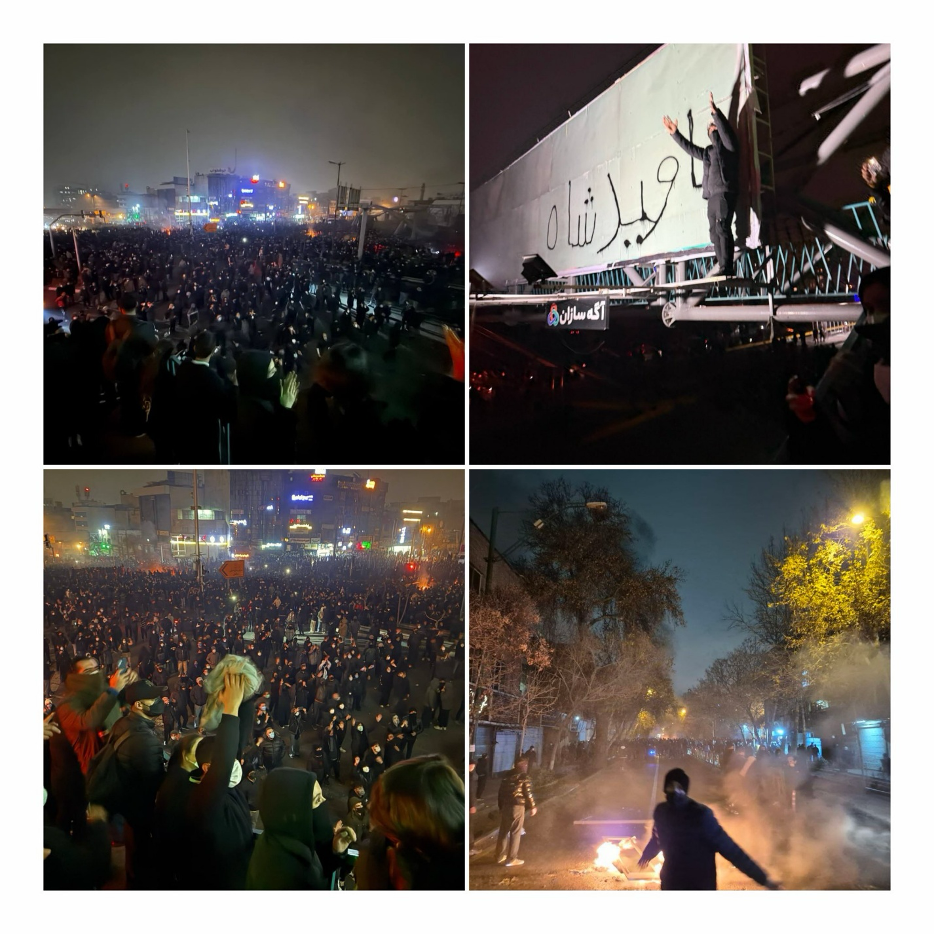
Calling it protests downplays its magnitude and effect; this is a revolution happening before our eyes, and whether it will succeed is yet to be seen, but what is clear is that there is no going back! The situation is grave; all means of communications, including internet and telephones, are cut in Iran, and at least 12,000, and as many as 20,000, are feared dead, making it potentially the most deadly modern revolution. It started on December 28th, 2025, as Tehran’s central Bazaar shopkeepers closed down their shops to protest peacefully the deteriorating economic situation. The government responded harshly, which soon turned into an all-out revolutionary call for regime change that spread across the country, encompassing at least 180 cities in all 31 provinces.
Although protests began amid deteriorating Iranian currency, it would be wrong to downplay them as an economic grievance. Even according to the government’s confidential study, only 22.5% supported a religious government. A survey conducted by GAMAAN institute based in the Netherlands on Iran in 2020 found that only 32.2% associated themselves with Shia Islam, while a similar number 31% either identified as atheist or non-religious. The gap between the Islamic Republic and the people it governs has been widening at a rapid rate. Iran has had 2 successful revolutions (1905-1911 and 1979) and many other revolutionary attempts in its modern history (such as 2022 Mahsa Amini), but this is unlike anything we have seen before; it encompasses all parts of society beyond class, ethnic, and religious lines.
The revolution started leaderless and spontaneously, but the chants on the street overwhelmingly called for Crown Prince Reza Pahlavi. He has been living in exile since 1979 and has been an active voice against the Islamic Republic of Iran. This is particularly relevant since the 2017-2018 protests in Iran, when chants in support of the Pahlavi dynasty were heard in the streets amid the failure of the “reformist” government of former president Rouhani to enact any meaningful reforms despite success in diplomacy in signing a nuclear agreement. The protests escalated with Reza Pahlavi’s first official call to people to take to the streets on January 8th and 9th. Subsequently, this has renewed his call, with continued protests and mass strikes, as people go to the streets, shouting for Pahlavi’s return. He is the most recognizable opposition figure who has published a transitional plan for a post-revolutionary Iran that would transition Iran to either a republican or a constitutional monarchy based on a referendum. Also, the White House envoy Steve Witkoff has recently met secretly with the Crown Prince.
Other prominent figures of the opposition, including Nobel Peace Prize winner Shirin Ebadi and Abdollah Mohtadi, the secretary general of the Komala Party of Iranian Kurdistan, have raised their support for the Iranian uprising and sent an open letter to Donald Trump to take action and prevent the disaster in Iran. Much of the opposition seems united now, as defeating the regime remains the priority, particularly amid the ongoing genocidal massacre.
The regime has resorted to “shoot to kill” order, while shutting down the internet and communications to suppress the revolution behind the curtain with bloodshed as it has done in the past. For example, it killed over 1500 protestors in November 2019 in just a few days, when it had shut down the internet too, according to Reuters. From the sporadic videos that get out of Iran via a few active Starlink networks in Iran to reports from doctors, the level of violence that the regime is resorting to is unprecedented. Based on the most conservative estimates, there were at least 2,000 killed in Iran on January 8th and 9th alone.
Why is this time different? Several recurring themes in successful revolutions appear to have converged. Unlike previous uprisings that were demographically siloed—the 2009 uprising was predominantly middle class, and the 2019 uprising was more working class—the ongoing protests are cross-class and widespread across the country. It is hard to estimate exact numbers, but reportedly millions have hit the streets in Iran, with a threshold of 3.5% of the population actively participating in the uprising, which has exceeded historic standards and significantly increased the likelihood of regime change.
While protests since December 2017 have decisively shifted toward regime-change rhetoric, they have consistently faltered due to a critical vacuum: the absence of unified leadership. This deficit is fatal; sociologist Jack Goldstone notes in his analysis of revolutionary dynamics that successful revolutions require more than just mass mobilization or state breakdown. They demand a cohesive leadership capable of uniting diverse coalitions and maintaining strategic discipline. Without this structure, previous uprisings suffered from a “tactical freeze” (to put it in Tufekci’s words), unable to translate street anger into a sustainable transfer of power. This is particularly crucial when facing an ideologically well-entrenched totalitarian state.
Crucially, the collapse of the regime’s regional hegemony—triggered by the geopolitical shockwaves following October 7th—has served as the structural catalyst for this revolution. The dismantling of Iran’s ‘forward defense’ strategy, marked by the decisive defeat of Hezbollah and the death of Hassan Nasrallah in September 2024, followed swiftly by the fall of Bashar al-Assad, stripped the Islamic Republic of its strategic depth. However, it was the humiliating defeat in the 12-Day War that delivered the terminal blow, shattering the myth of the regime’s image of strength among its loyalist base and emboldening the opposition.
Israel purposefully bombed riot police HQs in the short war. This trajectory aligns precisely with the scholarship of Theda Skocpol, who argues that successful social revolutions are rarely sparked by domestic grievances alone; rather, they are triggered when military defeat and foreign pressure fracture the state’s “coercive apparatus,” rendering it unable to suppress internal dissent. Furthermore, the loss of proxies validates Randall Collins’ theory of “geopolitical overextension,” where the contraction of an expansionist state’s external empire precipitates a rapid collapse of its domestic legitimacy.” This is exemplified through the chants of protesters that shout “neither Gaza nor Lebanon, I sacrifice my life for Iran”.
Unsurprisingly, President Trump’s repeated threats to kill protesters have changed the calculus. So has his record—most notably ordering the 2020 assassination of senior IRGC commander Qasem Soleimani in Iraq, and his later involvement in the 12-Day War, including strikes on Iran’s nuclear facilities. Together, these actions have made the prospect of a foreign intervention—potentially in favor of the protesters—seem more plausible. Trump is currently weighing potential intervention in Iran and has said help is on the way, but it is questionable if he would intervene militarily, given that the US currently does not have a significant force in the region. However, should Israel participate, the situation would be different. This is a likely scenario, as Israel has been concerned with Iran’s expansion of its ballistic missile program.
Ironically, the Islamic Republic may welcome a potential short-term conflict with the US and Israel, given that not only it crossed Trump’s line by thousands of miles but has continued to provoke him by constantly mocking him and even broadcasting an image of him with the caption “bullets won’t miss this time” on the state TV. Feeling existential threats both domestically and externally, the regime may be calculating that goading Trump into attacking now, before the US can build up its forces in the region, and while things are unstable at home, offers better odds than waiting.
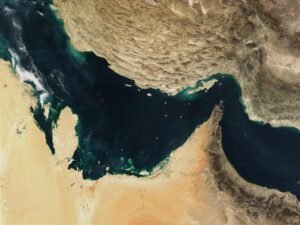
Iran’s strategic thinking may be that a premature American strike would be less devastating than one launched months from now when the US has an overwhelming force in place. With its short-range missile arsenal and naval capabilities still largely intact following the June 12-Day War, Iran could absorb an initial attack and then retaliate across the Persian Gulf, de demonstrating its ability to destabilize the region’s critical energy infrastructure. An intensive but brief conflict might allow Tehran to claim it stood up to American aggression, consolidate power internally, and negotiate from a position of strength—possibly even preserving pathways to restart its nuclear program.
However, this calculus may prove to be wishful thinking. Deliberately provoking a conflict that destabilizes Gulf shipping lanes and oil facilities would threaten global energy markets and could trigger a multinational coalition against Iran—potentially including Arab states like Saudi Arabia. While Riyadh has reportedly lobbied Washington against direct military intervention in Iran, an Iranian provocation that forces America’s hand and threatens regional stability might compel these states to join the response, leaving Tehran facing a far broader and more sustained campaign than it anticipated.
An ideal scenario for the regime (and nightmare for protesters) would be a mild and symbolic strike by the US, as Trump did in 2017 when 59 Tomahawk cruise missiles were aimed at Shayrat Airbase in Syria in retaliation for the Khan Sheikhoun chemical attack. Under this scenario, the Islamic Republic may also commit a retaliatory but completely symbolic attack, and both sides claim credit.
The Islamic Republic is facing the most existential threat in its 47-year lifetime and is therefore resorting to raw, unconstrained violence, killing thousands in just a few days. However, three crucial factors remain in the regime’s favor.
Firstly, the regime’s elite, despite superficial differences and disagreements, remains loyal and united, which, so far, has not cracked. For example, the reformist President Pezeshkian recently called the protesters “foreign linked-terrorists” and announced his support for the utmost suppression. The regime has a thick ideology, and the cost of defection is very high. As long as loyalty remains relatively low-cost, regime figures are likely to stay loyal. In 1979, however, Marxist-aligned revolutionaries carried out assassinations of generals and regime figures, which raised the cost of loyalty and helped make defection more likely. Today’s protesters are unarmed and largely unideological, and they do not impose similar costs on loyal regime figures. Importantly, as Levitsky & Way (2022) highlight, the revolutionary background of the regime and its survival of early violent crises (including the hostage crisis and Iran-Iraq war) generated enduring perceptions of existential threat that fostered a permanent “siege mentality,” thus strengthening elite cohesion through “linked fate.” In this context, it was viewed as catastrophic for the elite to treat any dissent or defection as an existential threat, as the cost of losing power.
Secondly, the regime has been able to massacre the protesters because its security forces remain very loyal. Its police forces have a budget larger than its conventional army, it holds a large ideological Basij militia, and importantly, it has two military forces: (1) the ideology-based para-military IRGC (Islamic Revolution’s Guardian Corps), officially tasked with protecting the regime, and (2) its conventional underbudget military, which is also filled with loyalist commanders. The parallel armed force structure helps deter one side from defecting. Importantly, they both lack military professionalism, a key driver of defection. Crucially, military defection is the “Iron Rule” of any revolution, as Katherine Chorley argues in her Armies and the Art of Revolution (1943): no revolution can succeed against a modern army that remains loyal and has the nerve to use its weapons. Additionally, the Islamic Republic has access to a wide array of its Iraqi-based Shia proxy militia groups, which it has deployed in the border province of Khuzestan.
Thirdly, the Iranian regime as a rentier state can still function as long as it can sell oil even at these low oil prices and higher costs of selling due to sanctions, as the country has a relatively low cost of oil production. It does not require a large support base to function, even though it faces a high inflation rate (42%), and it is trying to combat fiscal imbalance by increasing taxes significantly. During the uprising, the government implemented radical economic reforms by cutting subsidies, deeming it a good opportunity since protesters were already out on the streets. Nevertheless, the state and security apparatus can function as long as it is able to produce oil. The Islamic Republic has been effective in preventing an oil workers’ strike, unlike under the previous regime, where the strike paved the way for the Islamic Revolution.
It is difficult to predict how things will turn out in the following days. As Beissinger (2022) suggests in Revolutionary City, urban revolutions created “thickened history,” a state in which the pace of events accelerates and contingency becomes paramount; in this volatility, a single tactical error by the regime can dramatically alter the outcome. Armed forces remain loyal despite the staggering regime violence, so the chances of military defection remain extremely low. For example, in the first seven months of the Syrian revolution in 2011, Assad resorted to less killing, yet with 3,000 deaths, large parts of the Syrian Army had defected to create the Free Syrian Army. The Syrian Army was relatively professional, less ideological, and fractured, which facilitated defection. The key to the critical turning point may lie in the composition of the security forces. Now all eyes are on outside intervention to punish the regime as promised by President Trump. Iranians inside and outside of Iran have been pleading for R2P (responsibility to protect) to end the violent massacre and further loss of lives, as thousands could be mass executed on the charge of moharebeh (a legal term meaning “war against God”), and summary executions are already taking place. A significant outside intervention through aerial strikes could fracture the regime’s command and control, empower the protesters, and facilitate the defection of the less loyal armed forces. The regime knows these possibilities and is trying to suppress the protests as soon as possible with a bloodbath.
Whether the revolution succeeds or not, boundaries have dissipated, and lines have been crossed from which there is no return. Millions of Iranians are mourning the loss of loved ones; the fury and hate born out of this grief may eventually topple the regime that has inflicted this pain, as Iranians have demonstrated extreme courage and valor in their many revolutionary attempts.
Bibliography:
Academic Sources
Beissinger, Mark R. “The revolutionary city: Urbanization and the global transformation of rebellion.” (2022): 1-592.
Chorley, Katherine. Armies and the Art of Revolution. 1943.
Collins, Randall. “Prediction in macrosociology: The case of the Soviet collapse.” American Journal of Sociology 100, no. 6 (1995): 1552-1593.
Goldstone, Jack A. Revolutions: A very short introduction. Vol. 381. Oxford University Press, 2023.
Levitsky, Steven, and Lucan Way. “Revolution and dictatorship: the violent origins of durable authoritarianism.” (2022): 1-656.
Skocpol, Theda. States and social revolutions: A comparative analysis of France, Russia and China. Cambridge University Press, 1979.
Tufekci, Zeynep. Twitter and tear gas: The power and fragility of networked protest. Yale University Press, 2017.
News and Media Sources
International News Outlets
Axios. “Pahlavi-Witkoff Iran protest meeting with Trump.” January 13, 2026. https://www.axios.com/2026/01/13/pahlavi-witkoff-iran-protest-meeting-trump
BBC News. “Iranian protests: Context from 2011 uprisings.” November 2011. https://www.bbc.com/news/world-middle-east-15304741
BBC News. “Iran protests update.” December 2025. https://www.bbc.com/news/articles/crr7gdr82e0o
BBC Future. “It only takes 3.5% of people to change the world.” May 13, 2019. https://www.bbc.com/future/article/20190513-it-only-takes-35-of-people-to-change-the-world
CBC News. “Iranian man death sentence.” https://www.cbc.ca/news/world/iranian-man-death-sentence-9.7043914
CBS News. “Iran protest death toll over 12,000 feared higher – video shows bodies at morgue.” https://www.cbsnews.com/news/iran-protest-death-toll-over-12000-feared-higher-video-bodies-at-morgue/
CNN. “Trump weighs potential military intervention in Iran.” January 11, 2026. https://www.cnn.com/2026/01/11/politics/trump-weighs-potential-military-intervention-in-iran
Jerusalem Post. “Iran news coverage.” https://www.jpost.com/middle-east/iran-news/article-882923
NBC News. “Netanyahu plans to brief Trump on possible new Iran strikes.” https://www.nbcnews.com/politics/white-house/netanyahu-plans-brief-trump-possible-new-iran-strikes-rcna250112
Newsweek. “Iran regime protests live – Trump war strikes.” https://www.newsweek.com/iran-regime-protests-live-trump-war-strikes-11356005
Reuters. “Special Report: Iran’s leader ordered crackdown on unrest – ‘Do whatever it takes.'” November 2019. https://www.reuters.com/article/world/special-report-irans-leader-ordered-crackdown-on-unrest-do-whatever-it-take-idUSKBN1YR0QO/
Wall Street Journal. “Iran’s Gulf rivals warn U.S. against strike on Iran.” https://www.wsj.com/world/middle-east/irans-gulf-rivals-warn-u-s-against-strike-on-iran-1388236e War.gov [U.S. Department of Defense]. “Trump orders missile attack in retaliation for Syrian chemical strikes.” April 2017. https://www.war.gov/News/News-Stories/Article/article/1144601/trump-orders-missile-attack-in-retaliation-for-syrian-chemical-strikes/
Iranian and Regional News Sources
Iran International. “Coverage of August protests.” August 21, 2025. https://www.iranintl.com/en/202508212335
Iran International. “December 30 coverage.” December 30, 2025. https://www.iranintl.com/en/202512305363
Iran International. “January 1 coverage.” January 1, 2026. https://www.iranintl.com/en/202601016383
Iran International. “January 7 coverage.” January 7, 2026. https://www.iranintl.com/en/202601071907
Iran International. “January 10 coverage.” January 10, 2026. https://www.iranintl.com/en/202601103903
ISNA (Iranian Students News Agency). “Iran’s headline inflation up 1.8% to 42.2% in December.” https://en.isna.ir/news/1404100704060/Iran-s-headline-inflation-up-1-8-to-42-2-in-December
Human Rights and Advocacy Organizations
Human Rights Activists News Agency (HRANA). “Day thirteen of the protests: nighttime demonstrations continue amid internet shutdown.” https://www.en-hrana.org/day-thirteen-of-the-protests-nighttime-demonstrations-continue-amid-internet-shutdown/
Iran Human Rights. “Exclusive Interview: Physician treating protesters in Iran describes mass casualties, overwhelmed hospitals.” January 2026. https://iranhumanrights.org/2026/01/exclusive-interview-physician-treating-protesters-in-iran-describes-mass-casualties-overwhelmed-hospitals/
Research Organizations and Think Tanks
Brookings Institution. “The Islamic Republic of Iran: Four decades on – The 2017-18 protests amid a triple crisis.” https://www.brookings.edu/articles/the-islamic-republic-of-iran-four-decades-on-the-2017-18-protests-amid-a-triple-crisis/
GAMAAN (Group for Analyzing and Measuring Attitudes in Iran). “Iranians’ attitudes toward religion: A 2020 survey report.” August 25, 2020. https://gamaan.org/2020/08/25/iranians-attitudes-toward-religion-a-2020-survey-report/
National Union for Democracy in Iran Fund. “Emergency Phase v3.” July 2025. https://fund.nufdiran.org/wp-content/uploads/2025/07/EmergPhase_v3_ENG.pdf
Statista. “Cost breakdown of producing one barrel of oil in the world’s leading oil-producing countries.” https://www.statista.com/statistics/597669/cost-breakdown-of-producing-one-barrel-of-oil-in-the-worlds-leading-oil-producing-countries/
Social Media Sources
Instagram. Visual documentation of protests. https://www.instagram.com/p/DTVg9z0iEUn/
Trump, Donald. Truth Social post. https://truthsocial.com/@realDonaldTrump/posts/115888317758045915
YouTube. Video documentation. https://www.youtube.com/shorts/7e3UmbaUF_w
Note: This bibliography includes all sources hyperlinked in the original document. URLs and access dates are as they appeared in the document dated January 2026.